Abstract
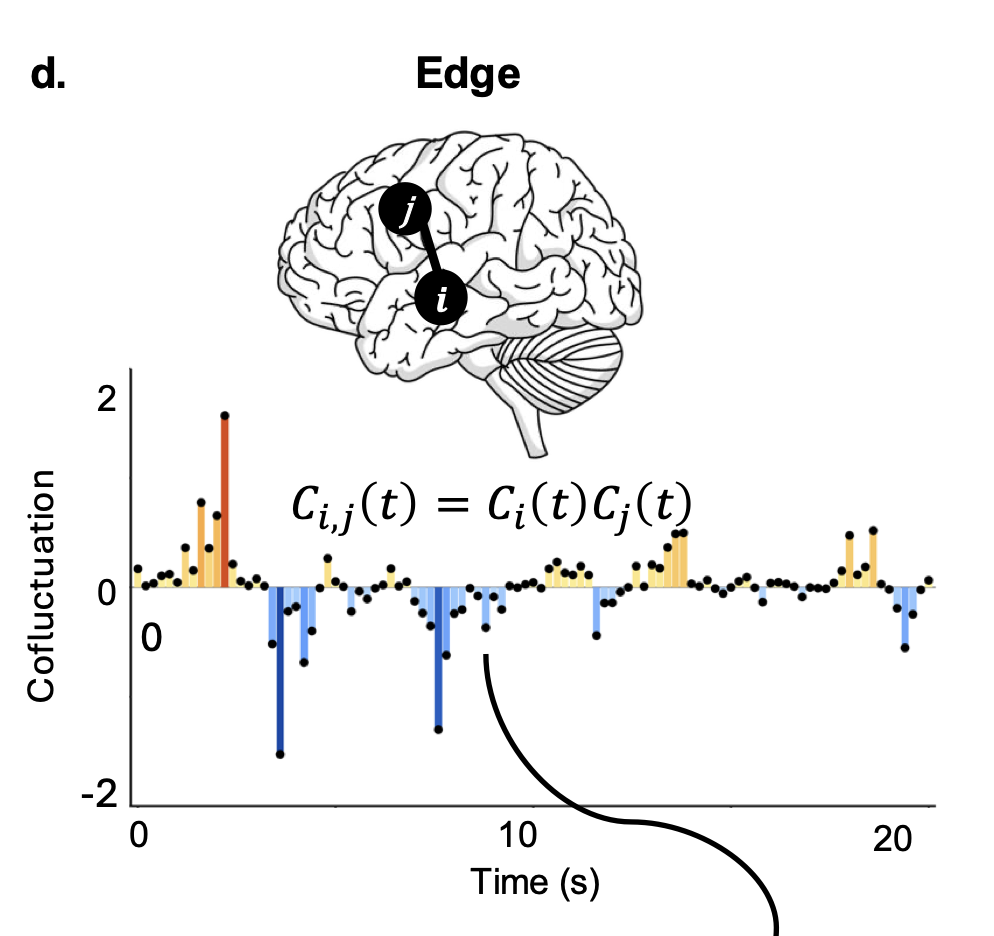
Functional connectivity in network neuroscience is traditionally characterized using time-averaged correlations between brain regions. While these summaries capture stable large-scale organization, they do not fully reflect the temporal structure of moment-to-moment interactions. Here, we investigate how the order of interaction used to represent brain dynamics shapes the organization recovered from neural data. We compare three interaction representations of fMRI dynamics: regional activation (node time series), pairwise co-fluctuations (edge time series), and higher-order triplet interactions (triangle time series); within a common topological framework using Mapper from topological data analysis (TDA). Across task and resting-state data, Mapper representations derived from pairwise co-fluctuations more distinctly segregate task conditions than activation-based or higher-order representations. This organization reflects structured coordination patterns beyond activation polarity and is driven by high-amplitude interaction events. Beyond task states, modularity quality computed across all Mapper representations is highest for edge time series and selectively associated with stable individual differences: higher modularity relates to higher conscientiousness and lower internalizing and externalizing symptom dimensions. Together, these findings suggest that behaviorally relevant information is reflected in the topology of moment-to-moment brain interactions. Topological analysis of interaction-level dynamics therefore provides a complementary and interpretable framework for linking large-scale neural coordination to cognition, personality, and mental health.